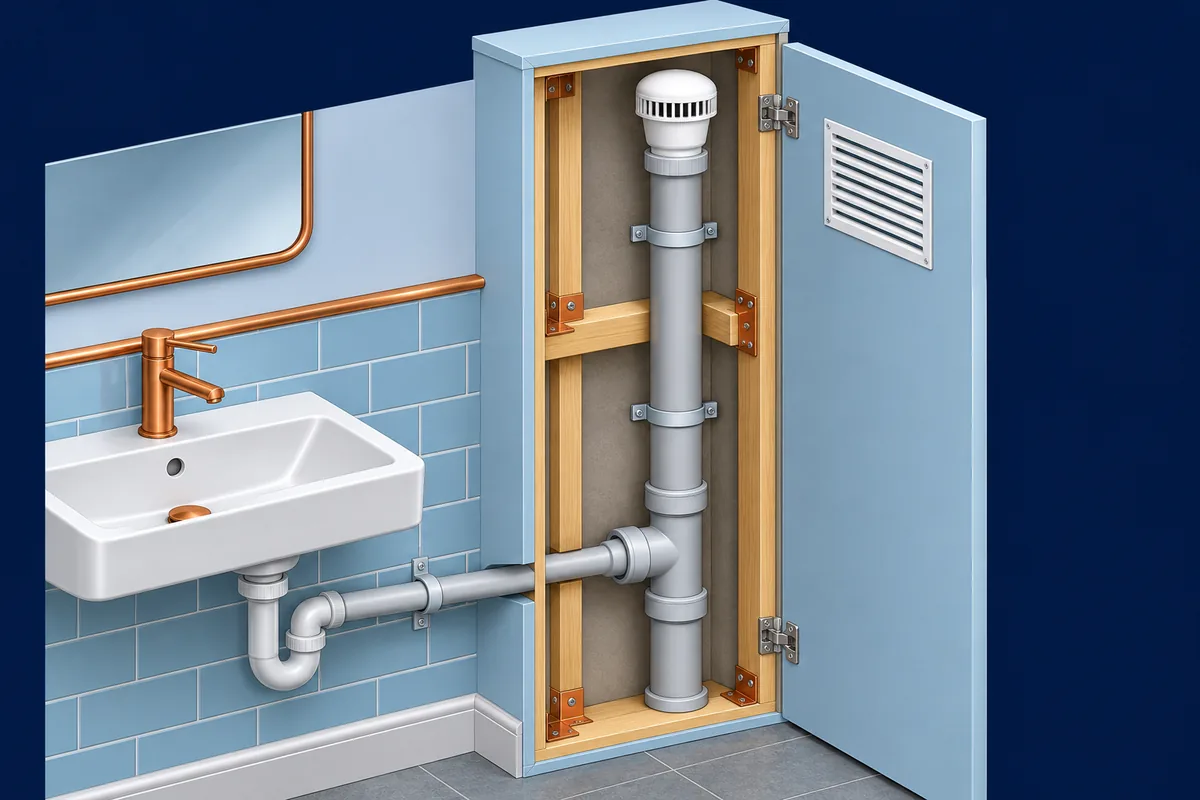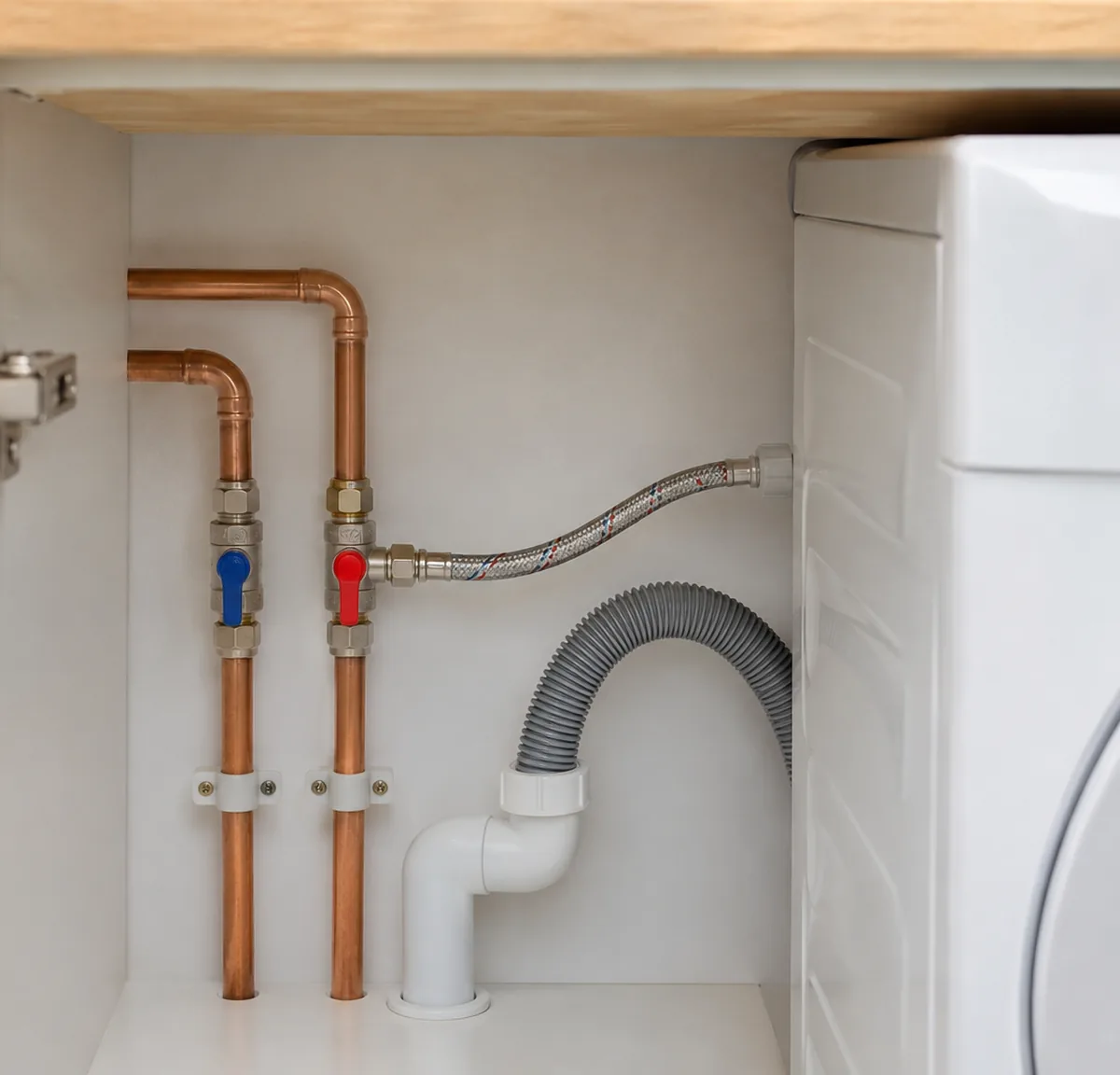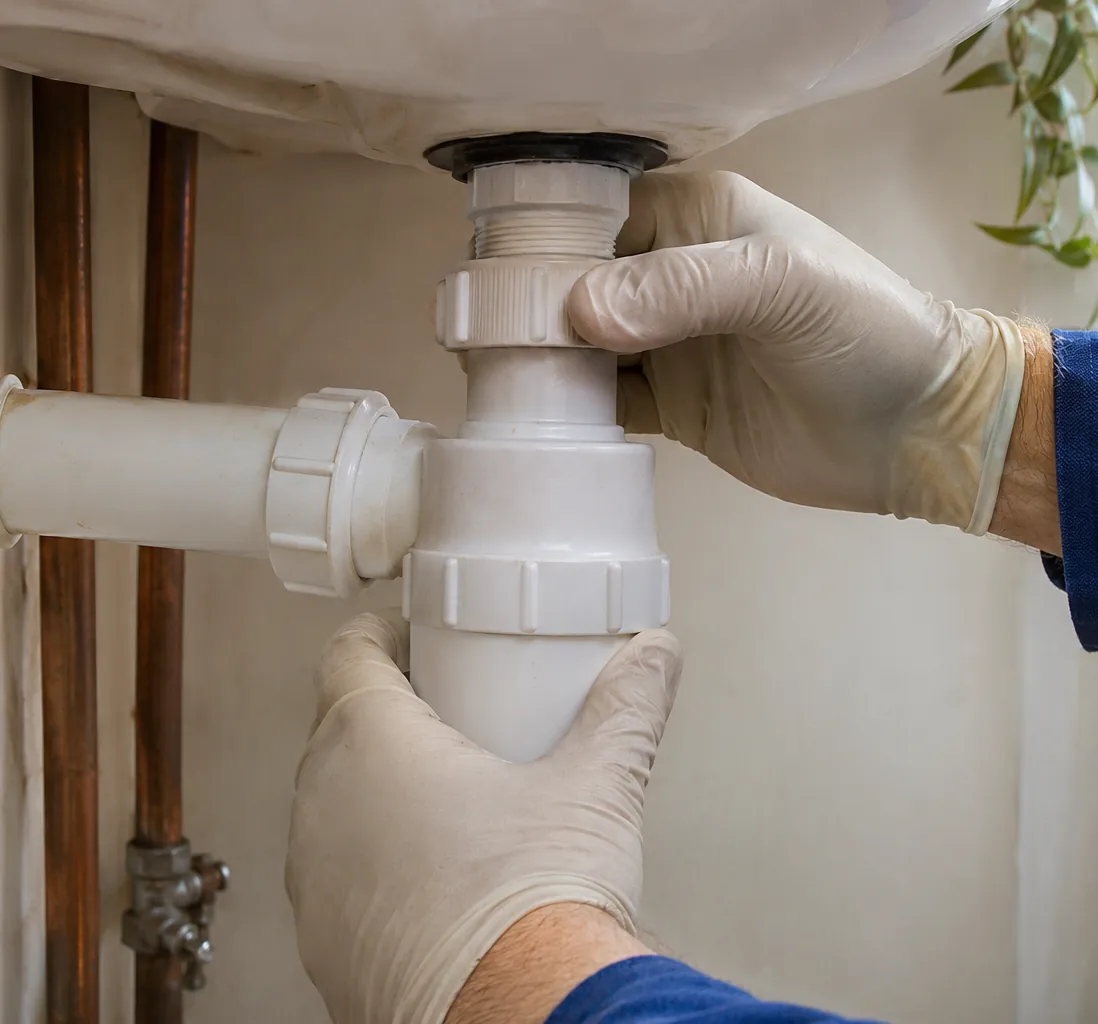
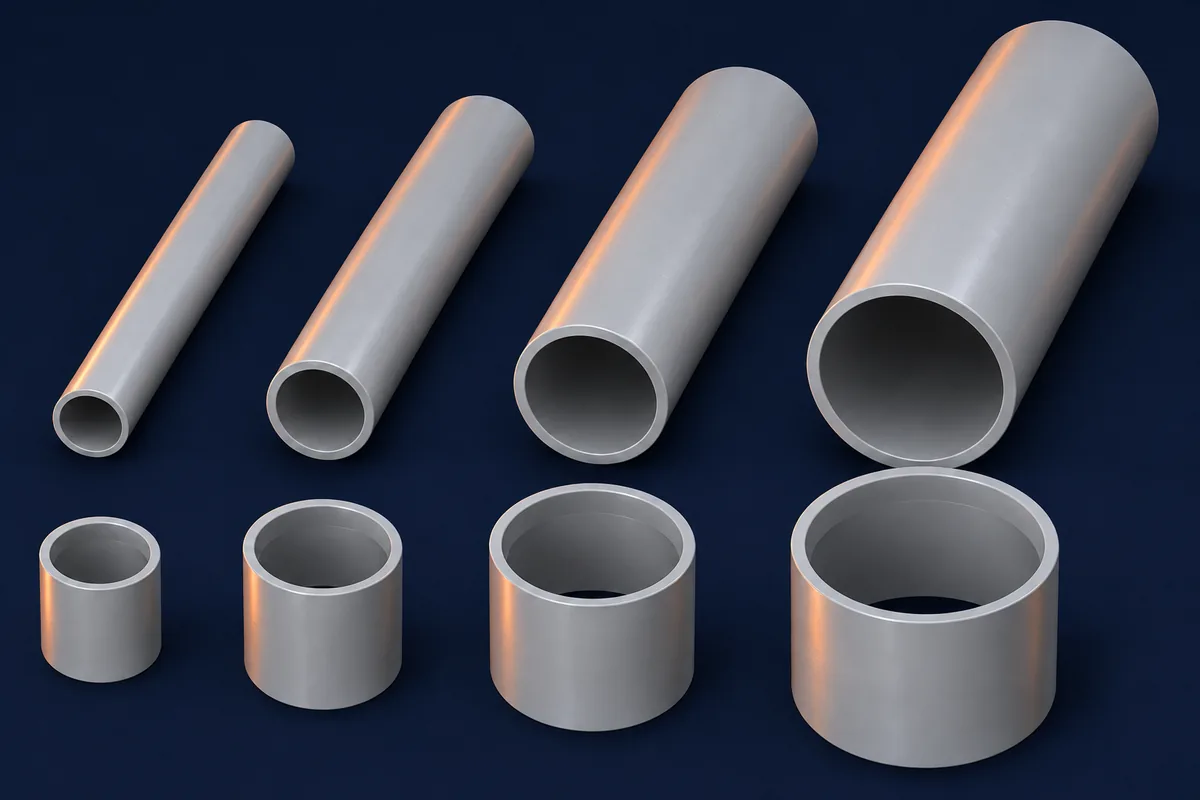
In a typical home a washbasin uses a 32 mm trap, a sink, bath, shower or washing machine uses 40 mm, and a toilet with an outlet over 80 mm uses a 100 mm branch, usually sold as 110 mm. The figures below are minimums from Approved Document H, Drainage and waste disposal, 2015 edition, for use in England.
Quick lookup
| Appliance | Usual size | Longest unventilated run shown | Fall (mm per metre) |
|---|---|---|---|
| Washbasin | 32 mm | 1.7 m | 18 to 22 |
| Sink or bath | 40 mm | 3 m | 18 to 90 |
| Shower | 40 mm | No separate figure used here; follow the maker's instructions | Follow the maker's instructions |
| Washing machine or dishwasher | 40 mm | No separate figure used here; follow the maker's instructions | Follow the maker's instructions |
| WC, outlet over 80 mm | 100 mm (110 mm outside) | 6 m, single WC | 18 to 90 |
Unventilated branch pipes
| Appliance | Pipe | Maximum length | Fall (mm per metre) |
|---|---|---|---|
| Washbasin | 32 mm | 1.7 m | 18 to 22 |
| Washbasin, shorter run | 32 mm | 1.1 m | 18 to 44 |
| Washbasin, shortest run | 32 mm | 0.7 m | 18 to 87 |
| Washbasin | 40 mm | 3.0 m | 18 to 44 |
| Sink or bath | 40 mm | 3 m | 18 to 90 |
| Sink or bath | 50 mm | 4 m | 18 to 90 |
| Single WC, outlet over 80 mm | 100 mm | 6 m (see below) | 18 to 90 |
| Single WC, outlet under 80 mm | 75 mm | 6 m (see below) | 18 to 90 |
The washbasin rows come from Table 2, which prints the small size as 30 mm while Diagram 3 calls it 32 mm. Diagram 3 also gives a curve for slopes between those lengths. The sink and bath figures come from Diagram 3.
Trap sizes and water seals
| Appliance | Trap diameter | Seal depth |
|---|---|---|
| Washbasin or bidet | 32 mm | 75 mm |
| Bath or shower | 40 mm | 50 mm |
| Sink, washing machine, dishwasher, food waste disposer | 40 mm | 75 mm |
| WC pan, outlet under 80 mm | 75 mm | 50 mm |
| WC pan, outlet over 80 mm | 100 mm | 50 mm |
Table 1 carries footnotes allowing shallower seals in certain cases, for example some appliances discharging straight to a gully. A pipe serving one appliance should be at least as large as its trap.
Toilet branches: 6 m or 15 m?
Approved Document H prints 15 m in a table and 6 m in a diagram. Table 2 lists 15 m for WC branches, allowing up to eight WCs with outlets over 80 mm, or one smaller-outlet WC. Diagram 3 shows a 6 m maximum for a single WC, with a minimum slope of 18 mm per metre.
Paragraph 1.19 says separate ventilation is not needed if length and slope do not exceed those in Table 2 or Diagram 3, and paragraph 1.20 refers to both when saying when to ventilate. Neither states which figure wins. Our reading is to design a single WC to 6 m, because that is the figure drawn specifically for it and it also satisfies the table. For anything longer, add ventilation or agree the design with building control first.
Table 2 also permits a flatter 9 mm per metre on long drain runs where space is restricted, but only if more than one WC is connected.
Converting fall to something you can measure
18 mm per metre is a drop of 36 mm over two metres, roughly 1 in 55. A spirit level with a packer of known thickness under one end is a practical way to check a short run.
Overflow pipe
An overflow is not a waste branch. FloPlast's overflow system, for example, is 21.5 mm solvent-weld PVC-U, with brackets at no more than 0.5 m centres. Do not use it to drain an appliance or fixture.
Discharge stacks
| Stack size | Maximum capacity | Restriction |
|---|---|---|
| 50 mm | 1.2 litres a second | No WCs |
| 65 mm | 2.1 | No WCs |
| 75 mm | 3.4 | Not more than one WC with outlet under 80 mm |
| 90 mm | 5.3 | |
| 100 mm | 7.2 |
A stack serving a WC with an outlet over 80 mm should be at least 100 mm, and a stack should not reduce in the direction of flow.
Nominal and actual sizes
Pipe is sold by nominal size, and the outside diameter differs between push-fit, solvent-weld, compression and older copper or imperial systems. Measure the pipe and check the fitting's stated compatibility before buying. Two pipes both described as 40 mm may need a transition fitting.
Worked example
A sink is to sit 2.6 m of pipe run from the stack. A 40 mm waste is within the 3 m figure. At 18 mm per metre the connection needs to be at least 47 mm below the trap outlet, plus whatever the bends and the stack fitting require. If the run grew to 3.5 m, 40 mm pipe would be over length, and the choice would be 50 mm pipe, ventilation or a shorter route. This is an illustration using the table, not a design for a particular room.
Symptoms that point to size or fall
| Symptom | Size or layout question to check |
|---|---|
| Trap gurgles or empties after a discharge | Is the run longer, steeper or narrower than the table allows? |
| Bath or shower drains slowly from new | Is there a flat length, a backfall or a sharp elbow? |
| Water appears in a shower when a basin empties | Do two appliances share a branch too small for both? |
| Smell from an appliance left unused | Has the water seal evaporated, or is the trap too shallow? |
| Blockage returns at the same point | Is there a joint or sag that can be reached for rodding? |
Safe checks are limited to running water, measuring accessible pipe and cleaning a trap with a bowl underneath. For a recurring blockage, see blocked sinks.
Common mistakes
- Increasing the fall to its maximum on a long small-bore basin run, which can pull the trap seal
- Running a pipe level, or backfalling it between brackets
- Joining several appliances into one small branch
- Using tight elbows where swept bends fit
- Burying joints and leaving no way to clear a blockage
- Exceeding a length limit without adding ventilation
If your layout falls outside the tables, see moving a waste pipe or send measurements through the contact form to have the run installed. Other drainage topics are collected under waste pipes.
Questions
What size is a toilet waste pipe?
Where the pan outlet is over 80 mm, Approved Document H gives a minimum branch of 100 mm, commonly sold as 110 mm outside diameter. Smaller outlets can use 75 mm.
What fall should a waste pipe have?
For most common unventilated branches the range starts at 18 mm per metre. The upper limit depends on the appliance, diameter and length.
Should a basin waste be 32 mm or 40 mm?
A basin trap is normally 32 mm. The pipe can be 40 mm for a longer run: Approved Document H shows up to 3 m at 18 to 44 mm per metre, against 1.7 m for 32 mm at 18 to 22.
What size is a washing machine waste?
Approved Document H gives a 40 mm trap with a 75 mm water seal. The pipe serving it alone should be at least the same diameter.
Can I reduce a waste pipe to a smaller size downstream?
Do not. A branch serving one appliance should be at least the size of its trap, and Approved Document H says a stack should not reduce in the direction of flow.